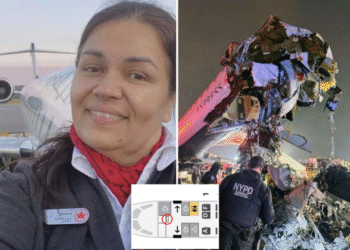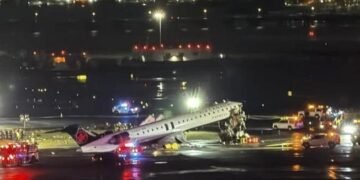
























The cockpit voice recorder from doomed Air Canada Flight 8646 has revealed how a routine journey turned into tragedy in just three minutes on Sunday.
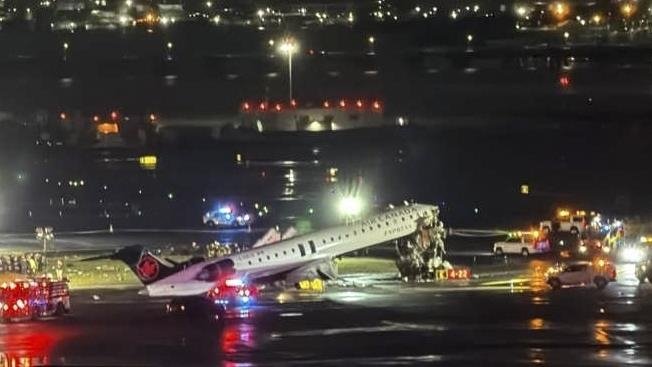
Both the pilot and co-pilot were killed, while more than 40 others were injured when the aircraft collided with a fire truck at LaGuardia Airport around midnight.


National Transportation Safety Board senior aviation investigator Doug Brazy on Tuesday provided new insight into the plane’s final moments, outlining a detailed timeline from the crew’s first contact with air traffic control to the fatal crash.


- At 3 minutes and 7 seconds before the flight from Montreal touched down in New York, the approach controller instructed the airplane to contact LaGuardia tower.
- 2 minutes, 45 seconds: Flight crew lowers landing gear.
- 2 minutes, 22 seconds: Flight Crew checks in with LaGuardia air traffic control.
- 2 minutes, 27 seconds: LGA tower clears the airplane to land on Runway 4 and advises they are second in line for landing.
- 1 minute, 52 seconds: Flight crew sets the flaps to 30 degrees.
- 1 minute, 33 seconds: Flight crew sets the flaps to 45 degrees.
- 1 minute, 26 seconds: An electronic “1,000” callout occurs from the enhanced ground proximity warning system, indicating the airplane is 1,000 feet above the ground
- 1 minute, 12 seconds: Flight crew confirms the landing checklist is complete.
- 1 minute, 3 seconds: An airport vehicle makes a radio transmission to the tower, but that transmission is blocked by another radio transmission by a source yet to be identified.
- 54 seconds: Flight crew acknowledges the airplane is 500 feet above the ground and on a stable approach.
- 40 seconds: LGA tower asks which vehicle needs to cross a runway.

- 28 seconds: Truck 1 makes a radio transmission to the tower.
- 26 seconds: Tower acknowledges that radio transmission.
- 25 seconds: Truck 1 requests to cross Runway 4.
- 20 seconds: Tower clears Truck 1 and company to cross Runway 4.
- 19 seconds: An electronic “100” enhanced ground proximity warning system callout occurs, meaning the plane is 100 feet above the ground.
- 17 seconds: Truck 1 reads back the runway crossing clearance.
- 14 seconds: Electronic “50” callout.
- 12 seconds: Electronic “30” callout.
- 12 seconds: Tower instructs a Frontier Airlines flight to hold position.
- 11 seconds: Electronic “20” callout occurs.
- 10 seconds: Electronic “10” callout.
- 9 seconds: Tower instructs Truck 1 to stop.
- 8 seconds: Sound consistent with airplane’s landing gear touching down on the runway is heard.
- 6 seconds: Pilot transfers controls from one pilot to the other.
- 4 seconds: Tower again instructs Truck 1 to stop
- 0 seconds: Recording ends.
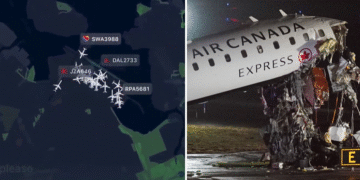
A FlightRadar24 rep has told The Post that the Air Canada jet, which originated from Montreal, was traveling as fast as 105 mph when it smashed into the fire truck, as seen in shocking video footage.
The details about the chilling lead-up to the crash surfaced as authorities revealed other deeply troubling issues about the night.
The fire truck involved in the crash was not equipped with a key device to track its movements around the runway — and it’s unclear whether the driver could even hear the air tower’s desperate pleas to stop, NTSB officials said.
NTSB chairwoman Jennifer Homendy added that the agency still doesn’t even know which air traffic controller was in charge of ground activity at the New York City airport at the time.
“It is not clear who was conducting the duties of the ground controller,” Homendy told reporters, detailing investigators’ early findings about the late Sunday crash.
“We have conflicting information. We have some information it was the controller-in-charge. We have some information it was the local controller.”
The confusion over what happened in LaGuardia’s tower as the jet began its descent extended to what happened on the ground, Homendy said.
She noted that the fire truck also did not have a transponder — a crucial piece of equipment that would give air traffic controllers a clear picture of where it was on LaGuardia’s runways.
“Should they have transponders? Yeah, they should,’’ she said.