



































The Mission Set Records In Space Exploration And Won Over The Hearts Of Many
“Houston, Integrity — we have you loud and clear,” said Commander Reid Wiseman aboard Integrity as the capsule made it safely into Earth’s atmosphere on Friday, April 10.
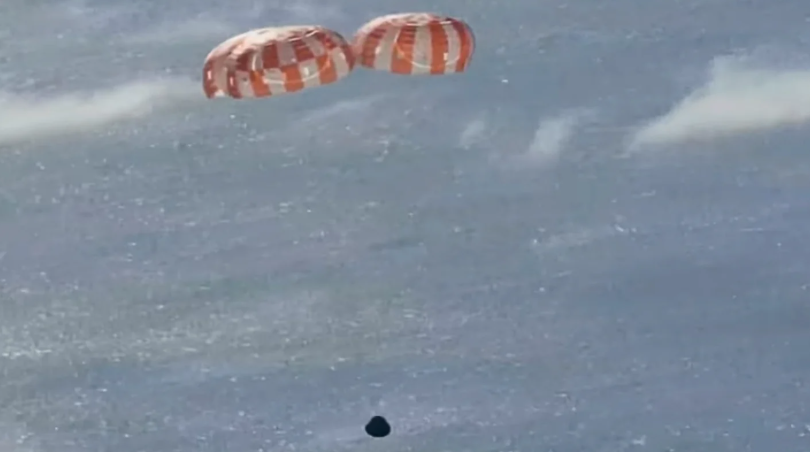
From there, NASA’s Artemis II mission concluded as its crew of four had a successful splashdown off the coast of California.


During their 10-day mission, the crew went around the Moon — something humans hadn’t done since the Apollo 17 mission in 1972 — observing its far side during a solar eclipse.
While on that stunning flyby, the crew even set a new record for sending humans the furthest into space, besting Apollo 13’s record from 1970 by 4,101 miles, for a total distance of 252,756 miles from Earth.
They also shared with the world some inspirational musings and statements on faith, as well as some heartfelt moments. There wasn’t a dry eye in space or on Earth when the crew named a crater after the mission commander’s late wife, Carroll.
The members of the crew aboard the Orion spacecraft, dubbed Integrity, became household names on this journey, with NASA’s astronauts including the first woman to fly around the Moon, Christina Koch; the first Black astronaut to fly around the Moon, Pilot Victor Glover; and Commander Reid Wiseman.
The fourth crew member was from the Canadian Space Agency (CSA), Jeremy Hansen.
With this mission, the hope is that humans will return to the surface of the Moon in 2028 during the Artemis IV mission. Much of the purpose of Artemis II was to test the Orion spacecraft and its Space Launch System to further deep space exploration.
The eyes of the nation, as well as the world, were on their return home on April 10.
At 7:53 p.m. EST on April 10, the Orion capsule began reentering the Earth’s atmosphere.
Going at a maximum velocity of 23,864 mph, or 33 times the speed of sound, upon reentering the Earth’s atmosphere, NASA foresaw that there would be a communication blackout for about six minutes.
Ahead of the reentry, NASA detailed some of what the crew would experience in the reentry process, noting:
“The crew module will separate from the service module, whose engines have steered them around the Moon and back to Earth. This will expose the crew module’s heat shield, which will protect the spacecraft and crew as they make their way back through Earth’s atmosphere and temperatures of up about 3,000 degrees Fahrenheit.”
The capsule splashed down, as expected, off the coast of San Diego, California, around 8:07 p.m. EST.
The United States Navy is on-site to help bring the astronauts out of the capsule, with the U.S.S. John P. Murtha awaiting their arrival for a routine medical examination.
Early reports indicated the four astronauts were all in good health upon being evaluated in the capsule.
Speaking from the U.S.S. John P. Murtha, NASA Administrator Jared Isaacman remarked of the crew, “These were the ambassadors from humanity to the stars that we sent out there right now. I can’t imagine a better crew than the Artemis II crew that just completed a perfect mission.”
He added, “We are back in the business of sending astronauts to the Moon, bringing them back safely, and the set up for a series of more. This is not a once-in-a-lifetime.”
Isaacman then stated NASA’s intention of establishing a base on the Moon, as well as eventually conducting crewed missions to Mars.